How High Ticket Closers Can Land Flight Attendant Jobs in 2026

Introduction
If you are a B2B high-ticket closer looking for a change of pace, you already know how to handle tough conversations, read people quickly, and stay calm under pressure.

Those same skills can open doors to an unexpected career path: flight attendant jobs.
Here is the thing. Many high-ticket closers reach a point where they crave something new. The daily grind of back-to-back calls starts to feel stale. You want more human connection, actual travel, and a role where your people skills shine in real time rather than through a screen.
The surprising truth is that the best flight attendants and the best high-ticket closers share a ton of overlapping abilities.
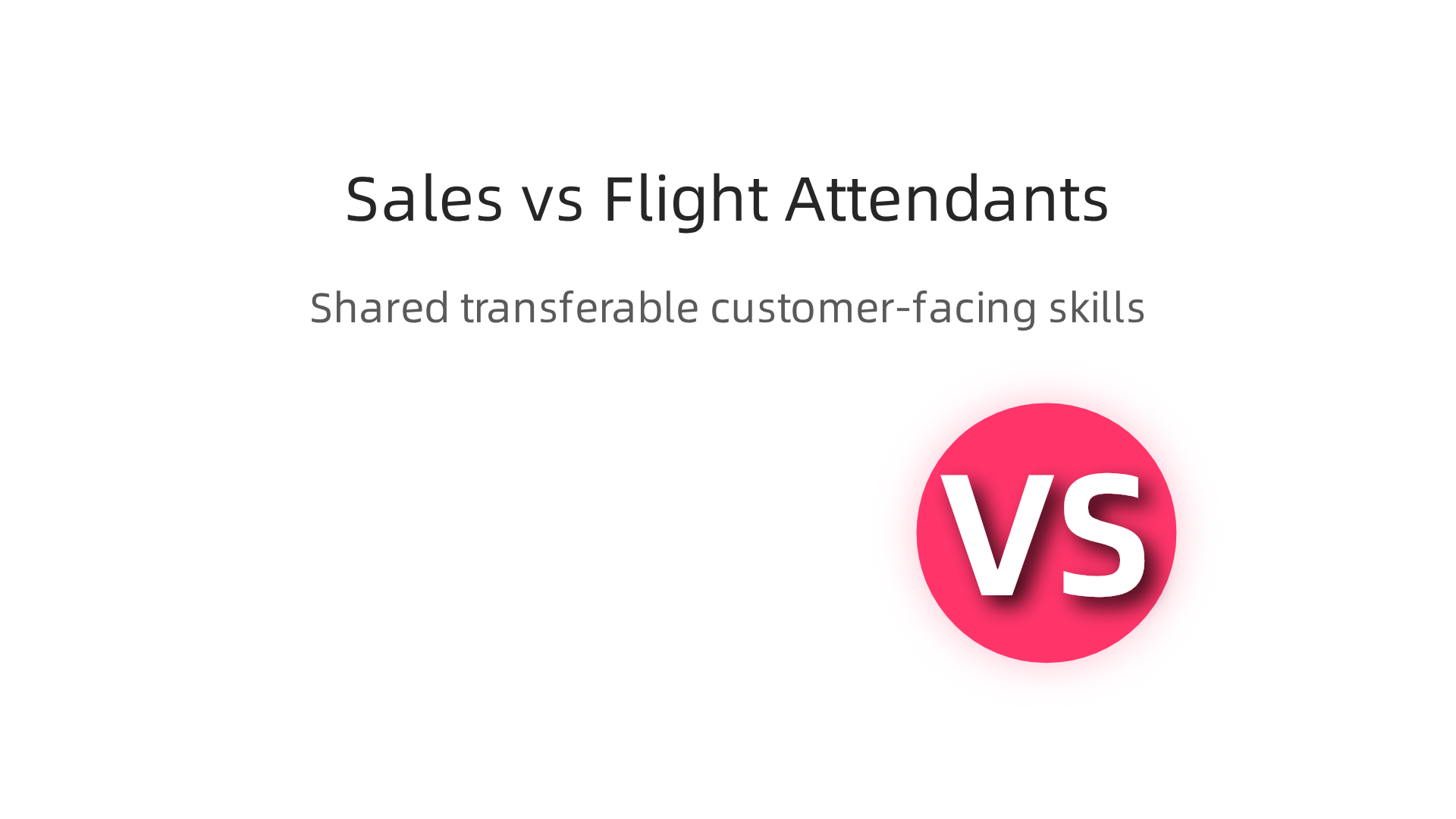
Think about it. You know how to build instant rapport with strangers. You can de-escalate tense situations without breaking a sweat. You manage your time like a pro and adapt when plans fall apart. According to research on the top transferable skills of cabin crew, skills like problem solving, leadership, and adaptability make former sales professionals ideal candidates for aviation roles.
These are not just random guesses. Airlines actively look for people who can represent their brand, handle stress gracefully, and deliver top-tier customer service. A recent guide on flight attendant career paths outside of an airline confirms that communication, safety awareness, and flexibility are some of the most valued traits in the industry.
So if you have been wondering whether your sales background could translate into something completely different, the answer is yes. This guide walks you through practical, research-backed steps to make that shift happen in 2026.
Maybe you have also considered other remote roles like medical courier jobs or remote nursing jobs. Those are solid options too. But if the idea of traveling the world while getting paid sounds exciting, flight attendant work might be your perfect fit.
You already have the foundation. Now let us build on it together.
Why Your Sales Background Is a Secret Weapon for Flight Attendant Jobs
You already have what airlines look for in new hires. You just have not made the connection yet. Let me show you how your sales experience fits perfectly into flight attendant jobs.
Communication and persuasion skills are the core of both roles. When you handle a sales call, you build trust fast. You listen closely. You tailor your message on the spot. Flight attendants do the same thing. They deliver safety briefings clearly. They answer passenger questions with patience. They keep people calm during turbulence. Research shows that communication and customer service are among the most valued transferable skills of cabin crew. You already have those skills dialed in. And if you want to build even stronger customer service abilities, you might also explore remote customer service jobs as another option.
Handling objections and tough situations comes naturally to you. In sales, you deal with hard objections every day. A prospect says no, and you find a way to turn things around. On a plane, passengers get frustrated or scared. A flight attendant needs to read the room and calm things down. According to Simple Flying, working under pressure and representing the brand are core skills for cabin crew. That is a skill set you already own. You know how to de-escalate tense moments without losing your cool.
Your resilience matches the irregular flying schedule. Sales is not always predictable. Your income shifts. Your pipeline changes. You face rejection and keep moving forward. Flying is the same way. Delays happen. Early mornings and long layovers are normal. You know how to stay focused when plans fall apart. Airlines value that kind of dependability.
Your background in high ticket closing makes you a strong candidate for flight attendant jobs. And if you ever want to explore other career paths that value similar skills, you can find practical advice on securing high ticket remote jobs work from home.
2026 Flight Attendant Hiring Trends: Demand, Top Airlines, and Geographic Hotspots
The post pandemic travel boom is still going strong in 2026. Airlines are scrambling to add more crew members to their teams.

If you have been wondering whether this is a good time to apply for flight attendant jobs, the answer is yes. The numbers back it up.
Demand for flight attendants is rising fast. According to the U.S. Bureau of Labor Statistics, employment of flight attendants is projected to grow 9 percent from 2024 to 2034, much faster than the average for all occupations. That means about 19,800 new openings each year. Another report from Zippia says we could see around 22,100 new flight attendant jobs over the next decade. And salaries have already jumped 22 percent in the last five years. The recovery is real.
Top airlines across the globe are expanding their crews. Major carriers in the United States, United Kingdom, Canada, Australia, and New Zealand are all hiring. The demand is not slowing. According to the GOOSE Aviation Recruitment Market Update, the global commercial aviation sector will need around 2.37 million new personnel by 2044. That includes flight attendants, pilots, and ground staff. The Inflight Institute estimates that nearly 50,000 new cabin crew jobs open up every single year. So whether you are looking at Delta, United, British Airways, or Qantas, there are opportunities waiting.
Where you apply can make a big difference. Competition varies by region. In bigger hubs like the United States, you might face more candidates, but there are also more openings. Smaller markets like New Zealand or parts of Canada might have fewer spots but less competition too. Timing matters here. The best time to apply is usually early in the year, from January through March. That is when airlines post the most openings after planning their seasonal schedules. You can check the January 2026 Airline Employment Tables from the Bureau of Transportation Statistics to see current employment numbers and spot which airlines are growing the fastest.
If you want to explore other career paths that use the same sales and communication skills, we have a guide on how to land customer service representative remote jobs that might help you keep your options open. But right now, the flight attendant job market is hot. Do not wait too long.
How to Spot and Avoid Flight Attendant Job Scams (A Guide for Career Changers)
The news about growing demand for flight attendant jobs is exciting, but it also attracts bad actors. Scammers know people are eager to land these roles, and they use that desperation against you. The Federal Trade Commission (FTC) warns that scammers advertise jobs the same way honest employers do: online, on social media, and even on legitimate job sites. So you need to know what to look for.
Common scam tactics you will see.
The biggest red flag is any request for upfront money. No legitimate airline will ask you to pay for training, uniforms, background checks, or a job placement fee.
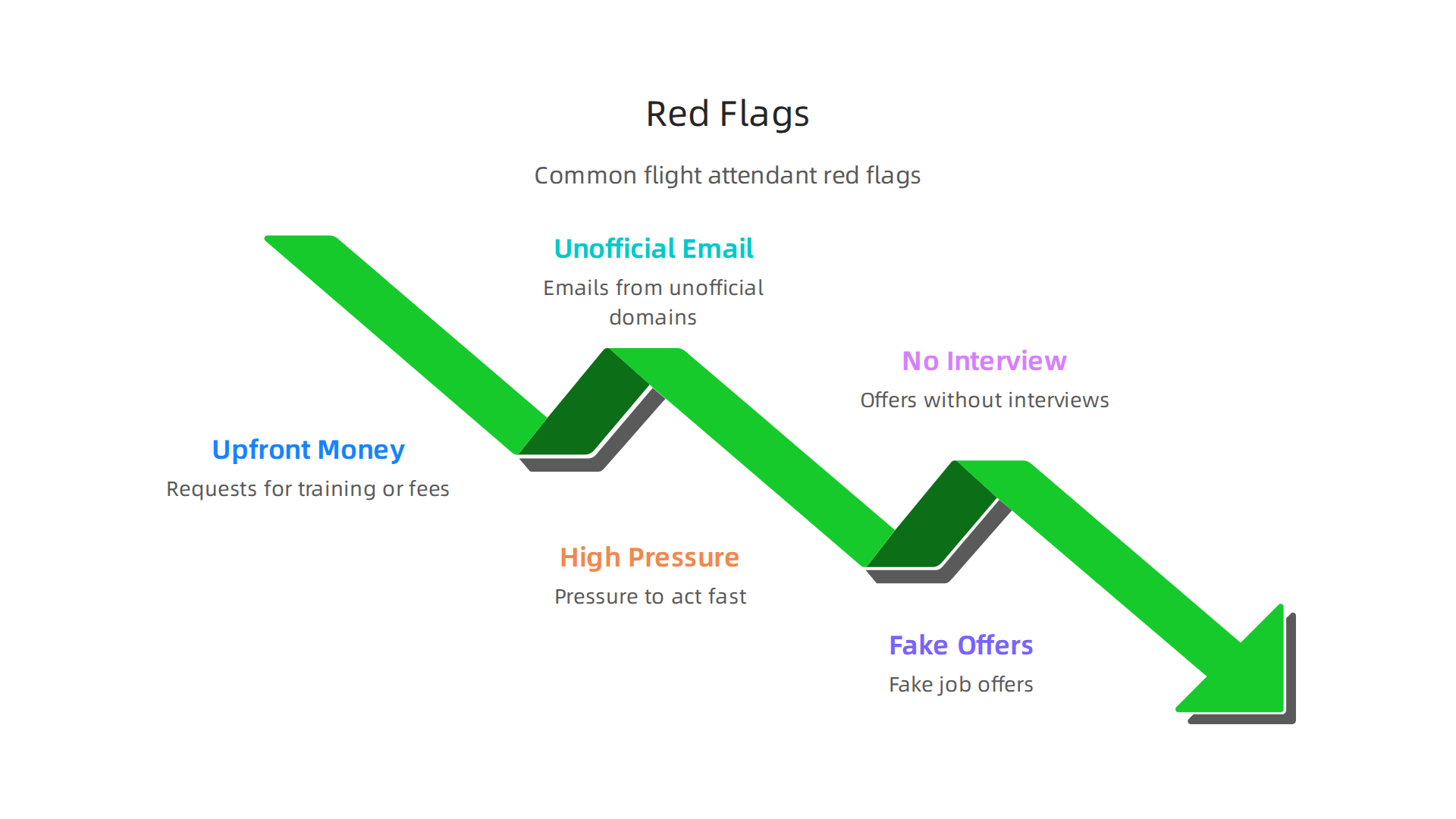
If someone tells you that you must pay to secure a flight attendant job, it is a scam. Another tactic is the fake job offer that arrives out of nowhere. Scammers send official looking emails with airline logos and offer you a position without an interview. They might ask you to complete a "training scheme" that costs hundreds of dollars. The FTC has advice on how to avoid these job scams, and they stress that real employers never ask you to pay to work.
Red flags to watch for every time.
Pay close attention to the email address. A real recruiter from Delta, United, or British Airways will use an email that ends with the airline’s official domain, like @delta.com. If the email comes from a Gmail, Yahoo, or any free address, run the other way. Also beware of any pressure to act fast. Scammers will say "spots are filling up" or "pay today to lock in your training date." They want you to rush before you think critically. The FTC Consumer Advice page on job scams explains that scammers often use high pressure sales tactics.
If you feel rushed, stop and verify.
Where to find the real flight attendant jobs.
Stick to verified sources only. Every major airline has a dedicated careers page on its official website. That is where you should apply. Government job boards like the U.S. Department of Labor’s CareerOneStop or the UK’s gov.uk/jobsearch are also trustworthy. If you are exploring other career paths, you might also want to know how to find legitimate office jobs near me in 2026, because the same scam awareness applies there too.
If you believe you have already been targeted by a scam, report it to the FTC at ReportFraud.ftc.gov. The FTC uses those reports to investigate and stop fraudsters. Stay smart, stay cautious, and keep your job search safe.
Mandatory Training and Certification Requirements for Flight Attendants in 2026
Once you have spotted a real opportunity, the next big question is what training you actually need. The scam artists we just covered will try to sell you bogus certificates. But the real requirements come from government agencies. And they vary depending on where you want to fly.
Who sets the rules.
In the United States, the Federal Aviation Administration (FAA) approves all flight attendant training programs. In the United Kingdom, it is the Civil Aviation Authority (CAA). Canada follows Transport Canada standards. Australia uses the Civil Aviation Safety Authority (CASA). And New Zealand has its own CAA. Every country has a specific set of rules you must meet before you can work.
The good news is that airlines handle most of this training for you. Major carriers run their own FAA approved programs. You do not need to get certified on your own before applying. You just need to get hired first.
What training actually covers.
A typical initial training program lasts between three and eight weeks. It is intense and full time. You will learn safety procedures, emergency protocols, first aid, and evacuation drills. You will also study customer service, aircraft types, and security procedures. There is a lot of memorization. You will have to pass written exams and practical drills.
Some programs also cover medical emergencies like using an AED or delivering a baby. The goal is to prepare you for anything that could happen at 35,000 feet.
Cost and financing options.
Here is the important part. Major airlines almost always pay for your training. You get paid a small salary during training, and the airline covers the cost of your certification.
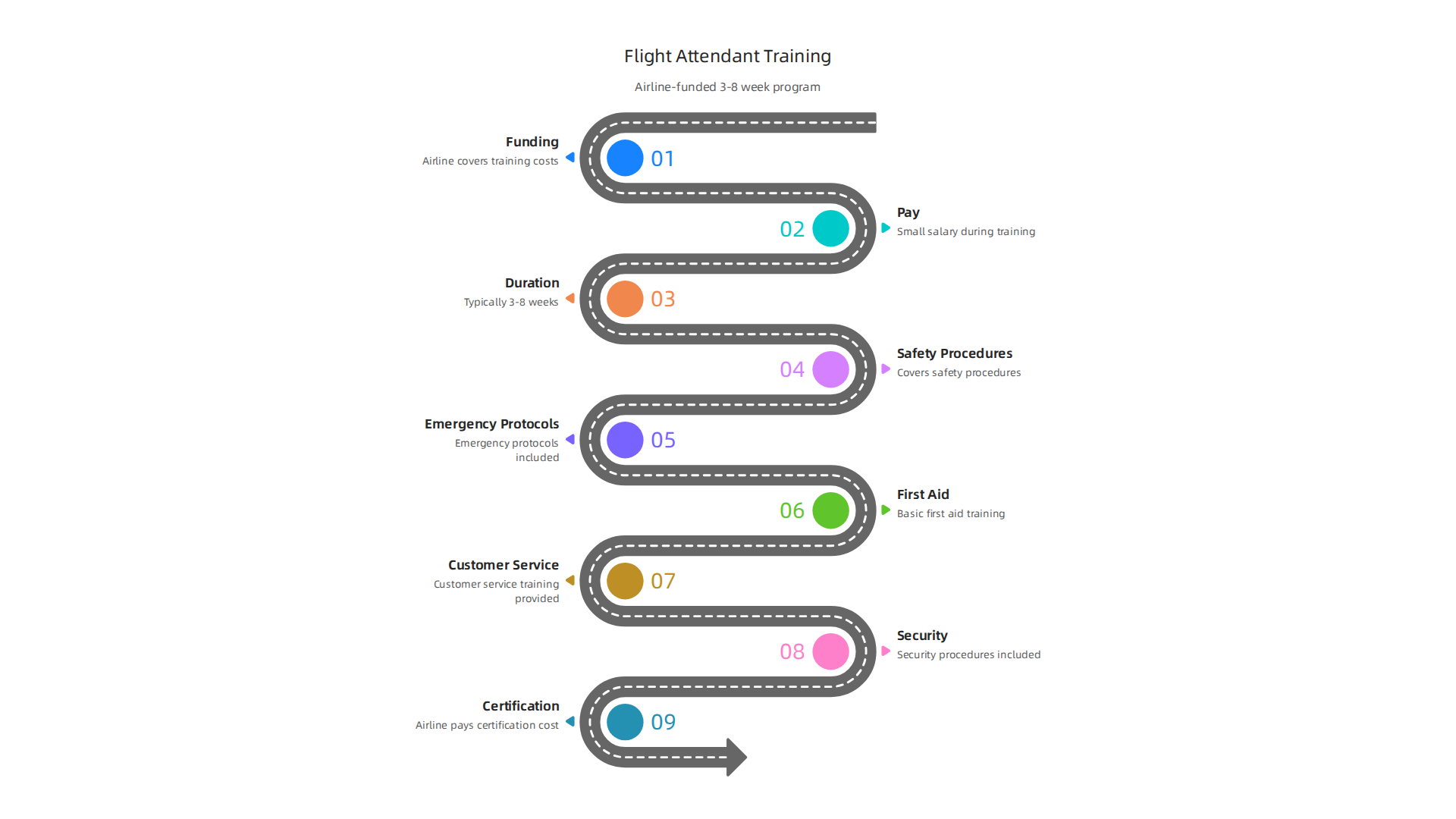
That is one way to spot a scam on the other side. If a company asks you to pay thousands upfront for training, it is not a legitimate major airline.
Some regional airlines or charter companies may ask you to cover part of the cost upfront. But even then, the training should lead to an actual job offer. If you are exploring other career paths where you can earn while you learn, you might also want to read about how to find high ticket remote jobs work from home and how to get them in 2026. The same principle of company funded training applies in many high paying remote fields.
What never to pay for.
Never pay for a guarantee of a job or a certificate that claims to make you a certified flight attendant without an airline program. The FTC Consumer Advice on job scams makes this clear. Real training comes from real airlines. If you pay a random company for a certificate, it will not be recognized by any major carrier.
Stick to the airlines that train you themselves. That is the only path that leads to a real career.
Tailoring Your Sales Resume and Acing the Flight Attendant Interview
Now you know the training is real and mostly free after you get hired. The next step is getting the actual job offer. Your resume and interview are your ticket. If you come from sales, you already have a huge edge. You just need to frame your experience the right way.
Resume tips that actually work.
Airlines want people who can handle pressure and talk to anyone. Your sales resume is full of proof for this. Start by quantifying your wins. Do not just say you made calls.

Say you handled 50 outbound calls a day and kept a 95% customer satisfaction score. That shows you can manage a busy cabin full of different personalities.
According to a helpful guide on writing a flight attendant resume, you should use a clean format and write a strong professional summary. Replace words like "sales quotas" with "safety and service goals" in your head. Every time you upsold a product, you were really solving a problem for that customer. That is exactly what you will do at 35,000 feet.
If you need more direction, looking at flight attendant resume examples for 2026 can show you exactly how to structure your own background. The main goal is to highlight customer service above everything else.
These same customer service skills open doors in other fields too. If you are exploring your options, you might also want to check out how to get remote customer service jobs while you wait for the right airline opportunity.
How to handle the interview.
The interview is where things get different from a regular job. Most airlines use scenario based questions. They might ask, "What would you do if a passenger refused to turn off their phone?"
Your sales training is perfect for this. In sales, you listen first and then offer a solution. Do the same here. Stay calm, explain how you would listen to the passenger, and walk through the rules with respect. Use a real story from your sales past to back up your answer.
There are also group exercises. The assessors watch how you work with others. Do not try to take over the group. Instead, help everyone stay on track. Make sure quieter people get a chance to speak. This shows you understand real teamwork. A real cabin crew works the same way.
Use sales stories to show you can adapt.
The best tool you have is a good sales story. Pick a time you had to change plans fast. Maybe a big client cancelled at the last second. Or you had to learn a new product in just one day.
Tell that story with a clear start, middle, and end. This proves you can handle the unpredictable life of a flight attendant. Airlines are hiring right now in 2026. They want people who are ready to learn and adapt quickly.
Your sales background is not a departure from your flight attendant goal. It is the foundation. You have practiced talking to strangers. You have hit targets. You have handled rejection. Now just reframe those skills for the cabin. You are ready to fly.
Flight Attendant Salary, Perks, and Career Progression in 2026
The demand for flight attendant jobs in 2026 is strong. The Bureau of Labor Statistics projects employment will grow 9 percent from 2024 to 2034, much faster than average. That means about 19,800 new openings each year. Flight attendant salaries have also jumped 22 percent in the last five years. Now is a great time to get hired.
How the pay works.
Flight attendants get paid by the hour. But here is the catch. You only get paid when the plane door closes. Boarding time, delays, and layovers are not always included in your hourly rate. However, airlines do provide per diem pay for meals and expenses when you are away from home.
Your first year is the toughest financially. Starting hourly rates at major US carriers range from about $25 to $35 per hour. With bonuses and per diem, many new hires earn between $28,000 and $40,000 in their first year. That sounds low. But the pay goes up fast.
Most flight attendants are union members. Union contracts set clear pay scales based on seniority. Every year you stay, your hourly rate goes up. After five years, you can earn $40 to $60 per hour. After ten years, even more. You also get paid more for international flights and extra duties.
The real perks people do not talk about.
The biggest perk is free travel. Most airlines give you free standby flights for yourself and discounted tickets for family. If you love exploring new places, this alone makes the job worth it.
You also get health insurance, retirement plans, and paid time off. Some airlines offer profit sharing too. In 2026, the US airline job market remains competitive for talent, so carriers keep improving benefits to attract good people. The job market outlook shows airlines are investing more in their crew to stay staffed.
Where you can go with this career.
Flight attendant jobs are not a dead end. You can move up the ladder. Here are the most common long term paths.
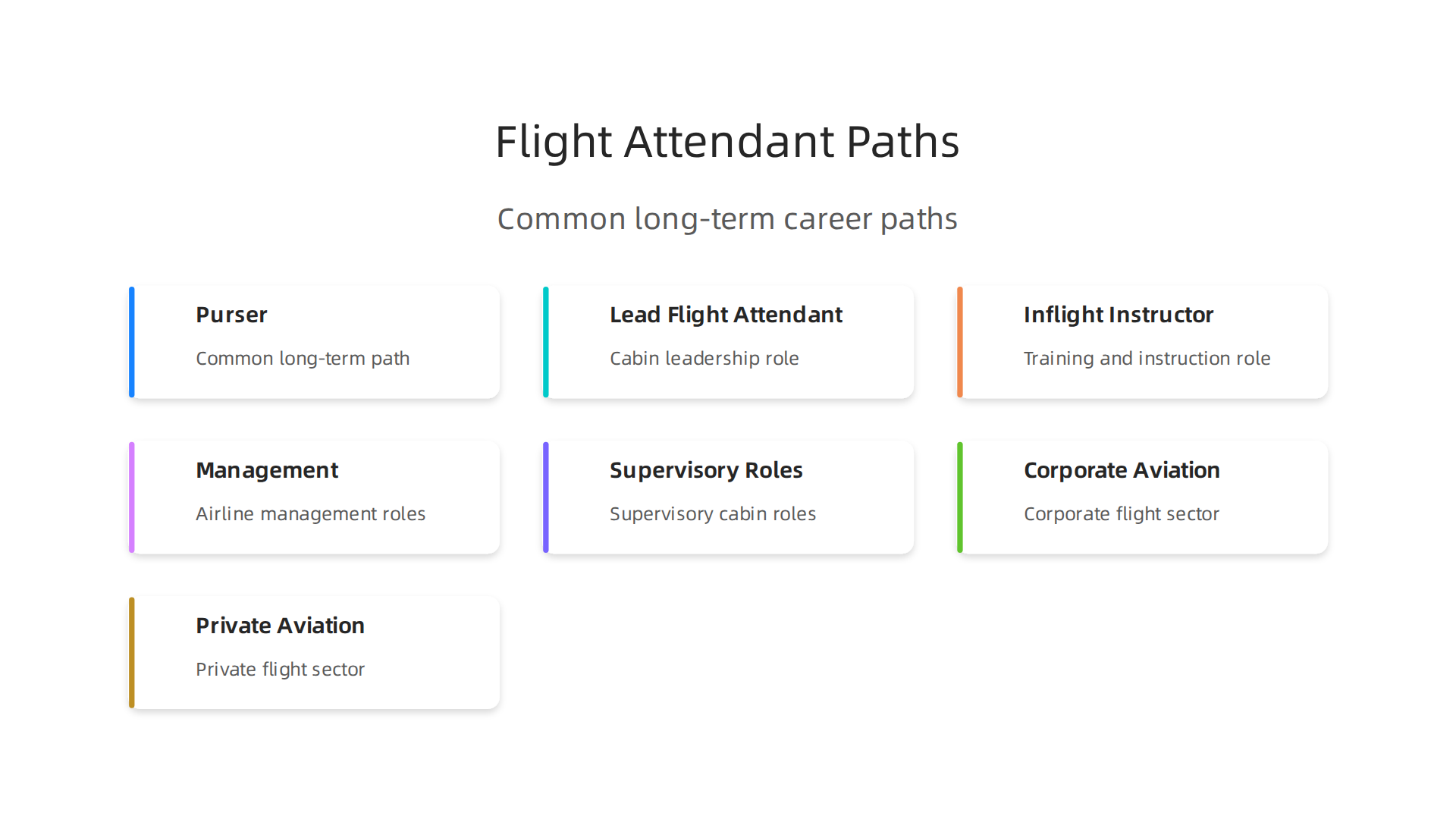
- Purser or Lead Flight Attendant. You take charge of the cabin and manage the crew on board. This role comes with a significant pay raise.
- Inflight Instructor. You train new hires in safety procedures and service standards. It is a stable schedule and good money.
- Management or Supervisory Roles. You work in an office helping to run the inflight operation. Think scheduling, recruiting, or quality assurance.
- Corporate or Private Aviation. After a few years at a major airline, you can move to private jets. The pay is higher and the work is more exclusive.
Some people also use the travel benefits to explore side careers. They take on remote nursing jobs or remote customer service jobs that only need an internet connection. This lets them earn extra income while flying part time.
If flight attendant jobs are not your final stop, you can use the skills you learn to move into other roles. Your sales background already taught you how to talk to people. Being a flight attendant teaches you how to stay calm in chaos. Those two things together open a lot of doors.
In 2026, the question is not whether you can get a flight attendant job. It is how far you want to take it. The path is clear. The pay gets better. The perks are real. And you get to see the world while you do it. If exploring other high paying career options interests you, read about high ticket remote jobs for more ideas.
Adapting from Remote Sales to the Airborne Lifestyle
So you have been working from home. You set your own hours. You took calls in your pajamas. Now you are thinking about flight attendant jobs. The switch sounds big. And it is. But your sales background actually makes it a lot easier.
Schedule irregularity vs. remote work flexibility
Here is the truth. Remote work gives you control over your time. Being a flight attendant takes that control away. At least at first. You will get a bid schedule. That means you choose your trips based on seniority. New hires often get weekends, holidays, and red-eye flights.
But here is the good news. You already know how to handle unpredictability. In sales, your pipeline changed every week. Deals fell through. Expectations shifted. You learned to roll with it. That same mindset helps you survive the irregular schedule.
The key is to stop fighting the schedule and start planning around it. Use your days off intentionally. And remember that the schedule gets better with seniority. After a year or two, you will have more say in your trips.
Health, wellness, and time management strategies
Your body will take time to adjust. Long flights, time zone changes, and airport food can drain you. Your sales skills taught you discipline. Use that same discipline for your health.

Carry a reusable water bottle. Drink more than you think you need. Pack healthy snacks like nuts and protein bars. Get compression socks to help your circulation. And never skip sleep. A well rested flight attendant is a safe flight attendant.
Time management is also different. You cannot just step away from your desk. But you can batch your activities. Meal prep on your days off. Set a wind down routine after a long trip. Treat your body like a tool you need to keep sharp.
Community and support networks for former sales pros
You might miss your remote sales community. The chat groups and Slack channels. But flight attendants have their own strong culture. You will find mentors who help you learn the ropes. Many of them came from other careers too.
Lean on your fellow crew members. They understand the lifestyle. And keep your old sales network alive. You can still check in with former colleagues during layovers. That connection matters.
One big advantage you have is your resume. When you apply for flight attendant jobs, your sales experience shines. You know how to read people, handle objections, and stay calm under pressure. Airlines love that. Check out these flight attendant resume examples to see how to frame your background. You can also find resume tips from Indeed that help you tailor your sales experience to the airline industry.
If the schedule feels too intense at first, remember it is temporary. Plenty of former sales pros use their travel benefits to explore side hustles like remote customer service jobs that fit around flying. The adaptability you already have is your superpower. Use it.
Summary
This guide shows high-ticket sales closers how to pivot into flight attendant jobs in 2026 by connecting the transferable skills you already have—communication, de-escalation, resilience—with what airlines actually hire for. It walks through current hiring demand and geographic hotspots, explains how to spot and avoid common job scams, and clarifies real training and certification rules (most major airlines pay for initial programs). You’ll get practical resume and interview advice that reframes sales wins as customer service and safety competencies, plus clear expectations for pay, perks, and career progression. The article also covers lifestyle adjustments from remote work to irregular flight schedules and offers health, time-management, and community tips to make the transition smoother. After reading, you’ll know where to apply, how to protect yourself from fraud, what training looks like, and how to present your background so airlines hire you.




Get in Touch


