Healthcare IT Remote Jobs: The 2026 Guide You Need

Introduction: Navigating the Lucrative World of Remote Healthcare IT
Picture this. You want a high-paying career you can do from anywhere.

The flexibility of remote work is no longer just a perk; it’s the new normal for many industries. In the tech sector, recent data shows a massive shift, with 47% of remote-capable employees now working fully remote and another 45% in a hybrid model. That means only a tiny fraction are stuck in an office full-time.
Now, imagine applying that freedom to one of the world’s most critical and stable industries: healthcare.
This is the powerful convergence happening right now. The healthcare industry is undergoing a massive digital transformation. Hospitals, clinics, and health networks are adopting new software, securing patient data, and moving systems to the cloud. This creates a huge demand for IT professionals who can support these critical systems. And more of that work than ever can be done from a home office.
This is the world of healthcare IT remote jobs. It’s a field bursting with opportunity for sales professionals, problem-solvers, and career switchers looking for meaningful, high-value work. We’re talking about roles where you can earn substantial commissions by selling vital software, or land a stable salary ensuring a hospital’s network stays secure from anywhere in the country.
But here’s the thing. With great opportunity comes a need for clear guidance. The landscape of remote healthcare IT jobs and remote it security jobs can be complex. How do you tell a legitimate, high-paying opportunity from an unreliable one? What skills do you actually need to break in?
If you’ve been searching for remote jobs with real career potential, you know it can be confusing. You might find generic advice that doesn’t apply to the specialized world of healthcare technology. That’s where this guide comes in.
Think of this as your trustworthy roadmap. We’re going to cut through the noise. We’ll help you understand what this field really is, show you how to identify the real remote healthcare it jobs, and outline the skills you need to develop to succeed. Whether you’re a seasoned sales pro or looking to make a switch, this is your starting point for building a lucrative career in a sector that truly matters.
To begin building your foundation, understanding how to find legitimate high-value roles is key. You can learn more about this process in our guide on the secret to finding high-ticket closing jobs. Now, let’s dive into what makes healthcare IT such a unique and rewarding field for remote work.
Understanding the Healthcare IT Remote Job Landscape in 2026
So, what exactly does a healthcare IT remote job look like today? It’s more than just tech support from your living room. In 2026, "healthcare IT" is a broad umbrella covering any role that uses technology to keep the healthcare system running. The best part? A huge portion of this work is perfectly suited for a remote setup.
Let’s define the scope. Here are common roles you can find as remote healthcare it jobs:
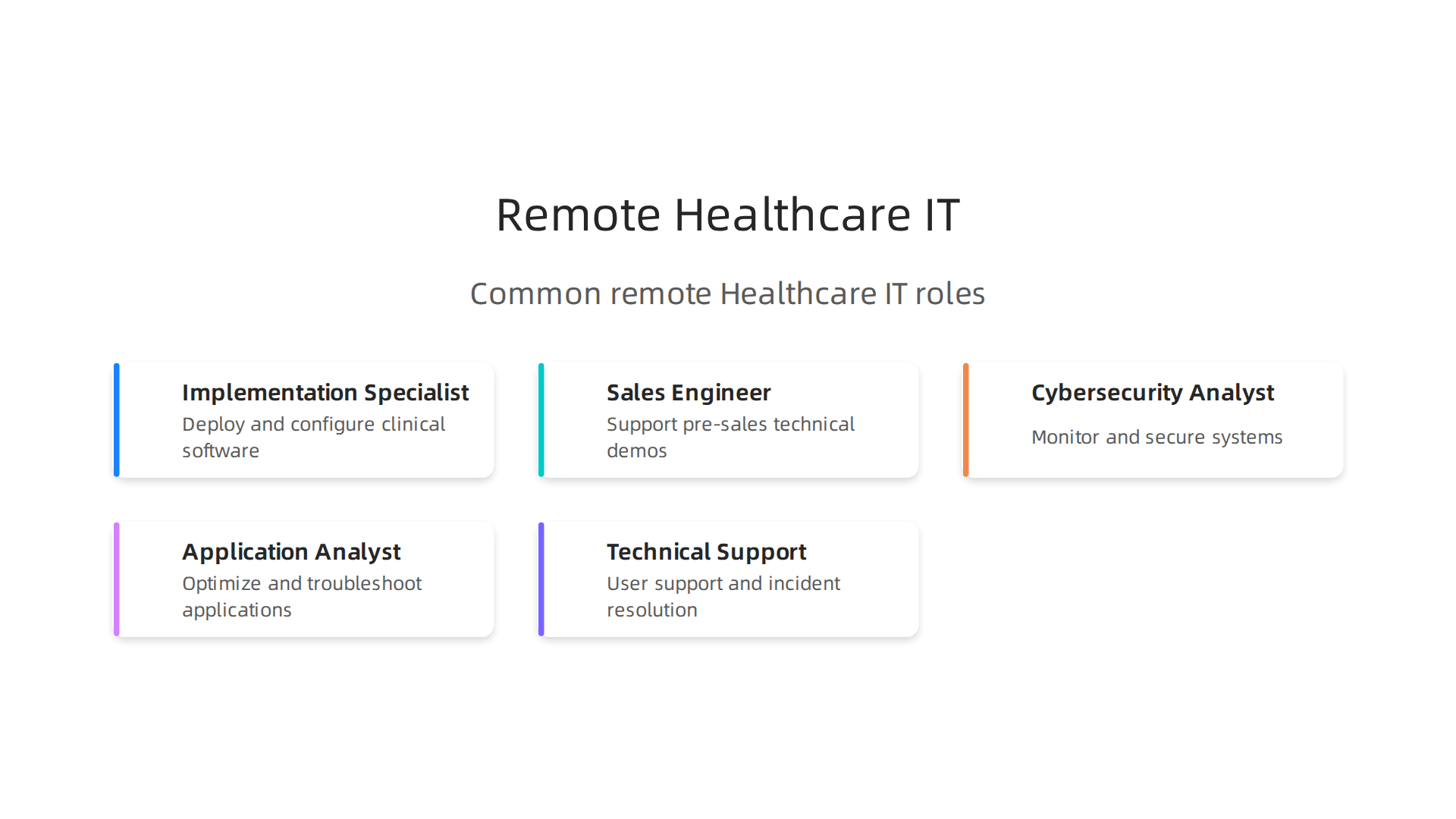
- Implementation Specialists: They guide hospitals through setting up new software systems. They do this via video calls, remote access tools, and detailed project plans.
- Sales Engineers & Solutions Consultants: These are the technical experts who support sales teams. They explain how complex software works to doctors and hospital administrators, all through online demos.

- Cybersecurity Analysts: Protecting patient data is a top priority. These professionals monitor for threats, update security protocols, and respond to incidents, often without needing to be in a specific server room.
- Application Analysts & Trainers: They specialize in specific software, like Electronic Health Records (EHR) systems. They help users, build reports, and conduct training sessions virtually.
- Technical Support & Help Desk: Providing tier-2 and tier-3 support for clinical software can often be done remotely with the right secure connections.
How Remote Work Has Evolved in Healthcare Tech
The shift to remote work isn’t a temporary blip. It’s the new foundation. Recent data shows that in the broader tech industry, 47% of remote-capable employees now work fully remote and another 45% work a hybrid model. Healthcare technology companies have followed this trend closely.
After the pandemic, healthcare providers, insurance companies, and tech vendors realized they could access a much wider talent pool by offering remote jobs. They also invested heavily in the cloud-based tools and secure remote access that make this work possible. While some frontline healthcare roles require a physical presence, the IT and sales teams behind the scenes have embraced flexibility. Studies on 2026 remote and hybrid work trends confirm that workplace dynamics have permanently evolved.
Busting Myths About Remote Healthcare IT Careers
Let’s clear up some common fears.
Myth 1: "Remote work isn’t secure enough for healthcare data."
This is the biggest concern, and it’s why it’s addressed head-on. Companies investing in healthcare technology are hyper-aware of security rules like HIPAA. If a role is offered remotely, the employer has already established secure, compliant ways for you to do your job. This often means using company-issued devices with advanced encryption, secure VPNs, and strict access controls.
Myth 2: "You’ll be stuck with no career growth."
Actually, the opposite is often true. Working remotely for a national or global company can expose you to more projects and leaders than being in a single office. Remote it security jobs and other specialized roles are in such high demand that proving your skills can lead to quick advancement. In fact, research indicates that senior-level roles are leading the way in flexible work arrangements.
Myth 3: "All the good jobs require you to be on-site."
While some implementation or integration roles may require occasional travel, the core day-to-day work for many positions is virtual. The key is knowing how to spot these legitimate opportunities. Understanding the landscape is your first step to finding a stable, high-value career path that offers both purpose and flexibility. For more targeted strategies on landing these roles, explore our guide on the secret to finding high-ticket closing jobs, which delves into the sales side of this tech-driven industry.
Top In-Demand Remote Healthcare IT Roles for Sales and Closing Professionals
Now, let’s talk about the high-earning side of healthcare IT remote jobs. For professionals with sales talent, this niche offers some of the most lucrative and stable remote jobs available today. We’re not talking about cold-calling vitamins. This is about closing six and seven-figure deals on software that hospitals and clinics depend on every single day.
Here are the top in-demand roles where your closing skills meet critical healthcare technology.
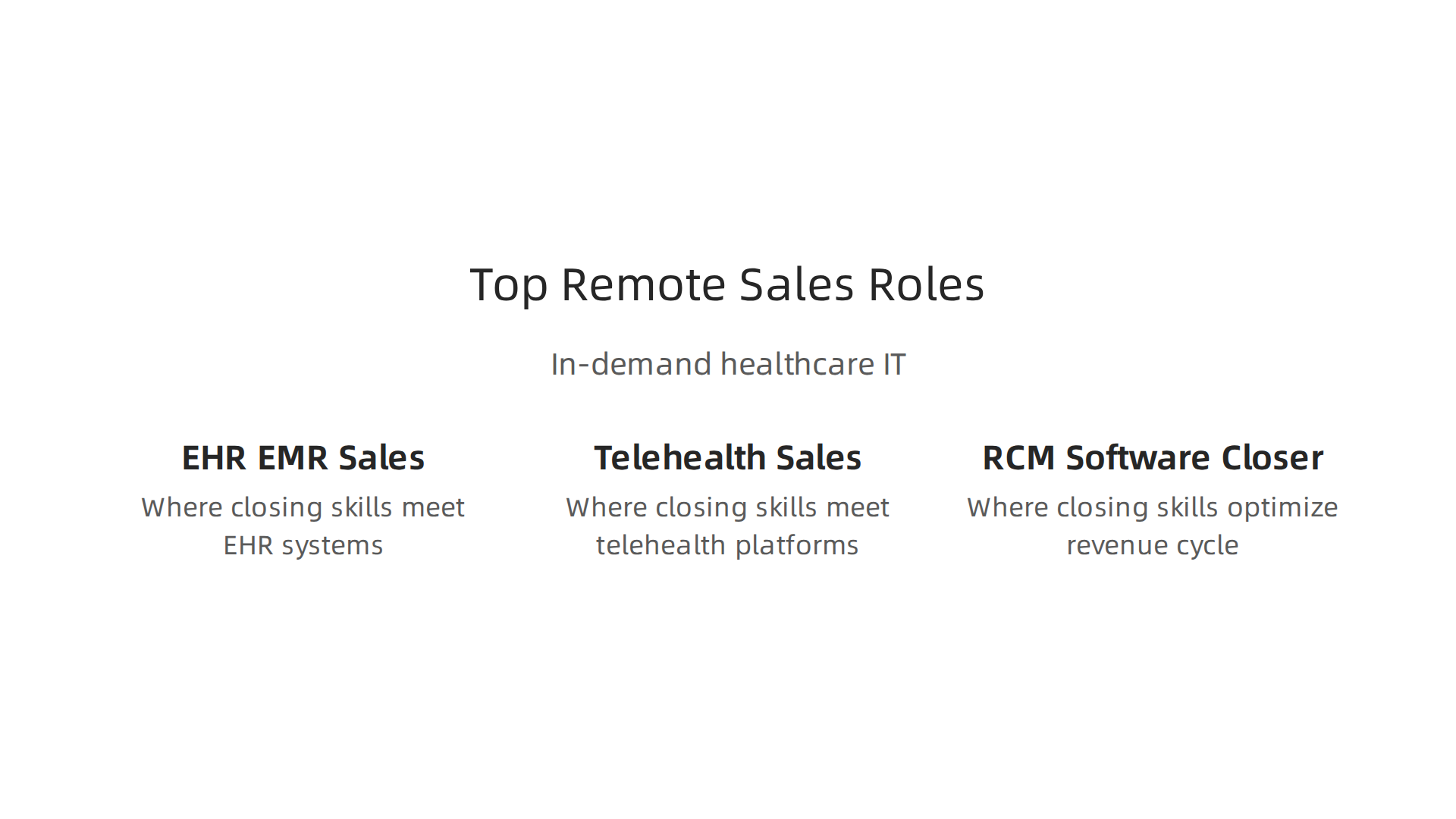
1. EHR/EMR Systems Sales Executive
This is the big one. Electronic Health Record (EHR) or Electronic Medical Record (EMR) systems are the digital backbone of modern medicine. Selling them is a complex, high-stakes B2B process.
- What You Sell: The core software platform that manages patient records, billing, and clinical workflows for entire hospitals or large medical groups.
- The Sales Cycle: Long and relationship-driven. It can take 6 to 18 months, involving multiple stakeholders: doctors, nurses, IT directors, and C-suite executives (like the CFO and CEO).
- Earning Potential: This is a true high-ticket role. Deal sizes often range from $500,000 to millions of dollars for enterprise contracts. Commission structures are highly rewarding, with top performers earning well into the mid-six figures. As a reference, salaries in health information technology can reach up to $173,000, and sales roles with commission on these large deals significantly exceed that range.
2. Telehealth Platform Sales Specialist
The telehealth boom is permanent, and clinics are constantly seeking better platforms to connect with patients remotely.
- What You Sell: The software that enables video doctor visits, remote patient monitoring, and digital patient communication.
- The Sales Cycle: Medium length (3-9 months). You’re selling to healthcare administrators and practice managers looking to improve patient access and operational efficiency.
- Earning Potential: Deal sizes vary widely based on the practice size and platform scope, often from $50,000 to $300,000 annually on subscription models. Commissions are strong, and this market is still growing and competitive. Industry reports confirm that healthcare IT jobs are expected to see steady growth for the next decade, with telehealth being a major driver.
3. Revenue Cycle Management (RCM) Software Closer
If you love talking about efficiency and money, this is your niche. RCM software automates medical billing, coding, and claims processing to ensure healthcare providers get paid.
- What You Sell: Solutions that reduce billing errors, speed up payments, and maximize revenue for hospitals and large physician groups.
- The Sales Cycle: You’re primarily dealing with office managers, billing directors, and CFOs. The cycle is often 4-8 months, as you must prove a clear return on investment (ROI).
- Earning Potential: Very high. You’re directly impacting the client’s bottom line. Contracts are often percentage-based on recovered revenue or large annual SaaS fees, leading to substantial commissions. Listings for related remote medical sales roles highlight earning potentials of $2,000 or more weekly, and specialized software sales can command even higher premiums.
The Hybrid Powerhouse: The Solutions Consultant
This is a critical role mentioned earlier that deserves a deeper look for sales-focused professionals. You might not carry a quota, but you are the key to closing the deal.
- The Role: You partner with the sales executive as the technical expert. You run the live software demos, answer deep technical questions, and architect how the solution will fit into the client’s specific environment.
- Why It’s a Great Remote Career: You get to solve complex puzzles and build credibility without the direct pressure of a quota. Your deep product knowledge makes you invaluable. Compensation is typically a high base salary plus a performance bonus tied to the sales team’s success, with total packages easily reaching $150,000 to $250,000+. Job boards show many remote healthcare consultant roles with this blend of skills in high demand.
Navigating Compliance: Your Secret Weapon
In all these roles, understanding healthcare regulations like HIPAA isn’t just a footnote. It’s a major asset. When you can speak confidently about data security and compliance, you build immediate trust. Knowledge of these frameworks is so valuable that there are dedicated remote compliance HIPAA jobs paying between $61,000 and $400,000. For a sales professional, this knowledge helps you overcome a key objection before it’s even raised.
The path to landing these roles starts with understanding the landscape, just as it does in other high-value B2B sectors. The strategies for breaking into this specialized field share similarities with the approach needed for other lucrative niches, like the one outlined in our guide on FedEx sales jobs. It’s about identifying the need, mastering the product, and learning to navigate a complex sale. If you’re ready to translate your sales skills into a career that combines high income with real purpose, remote healthcare it jobs in sales and closing are waiting.
The Skills Gap: What You Need to Succeed Beyond Generic Sales
Knowing the top roles is one thing. But landing and excelling in these healthcare IT remote jobs requires a specific toolkit. You can’t just be a good salesperson. You need to be a good salesperson who speaks the language of healthcare. Here’s what separates the contenders from the closers in the world of remote healthcare IT jobs.

1. Mandatory Industry Knowledge: Speak Their Language
Your clients are doctors, nurses, and hospital administrators. To earn their trust, you must understand their world’s rules and pressures.
- HIPAA Compliance: This isn’t optional. The Health Insurance Portability and Accountability Act (HIPAA) is the law governing patient data privacy. You must understand it enough to explain how your product secures data. This knowledge is so valuable that dedicated remote compliance HIPAA jobs command salaries from $61,000 to $400,000. In sales, this knowledge turns a potential objection into a point of trust.
- Interoperability Standards (HL7, FHIR): Hospitals use dozens of systems. Your software needs to "talk" to them. Knowing terms like HL7 (a messaging standard) and FHIR (a modern data-sharing framework) shows you understand their integration headaches.
- Reimbursement Models: Healthcare runs on billing codes (CPT, ICD-10) and payment models from insurers and Medicare. If you’re selling RCM software, you need to grasp this. If you’re selling telehealth, you need to know how visits get reimbursed. Understanding their revenue is key to proving your value.
2. Essential Technical Acumen: Beyond the Brochure
You don’t need to be an engineer, but you must grasp the technical realities to build credibility and manage expectations.
- Product Integrations: How does your platform connect to a hospital’s existing EHR? Is it an API? A pre-built connector? You need to discuss this confidently.
- Data Security: This ties directly to HIPAA. Be prepared to discuss encryption, access controls, and audit logs. For roles in IT security jobs remote, this is the core skill, but for sales, it’s a critical layer of due diligence.
- Clinical Workflows: How does a nurse document a visit? What steps does a biller follow after a patient is seen? Understanding these daily processes helps you position your product as a seamless solution, not a disruptive tool. As industry reports note, mastering the intersection of tech and care is what makes professionals stand out in healthcare IT jobs in 2026.
3. Critical Soft Skills for Remote High-Ticket Closing
This is where your generic sales skills get upgraded for the high-stakes, virtual healthcare environment.
- Building Trust Virtually: You can’t share a handshake over Zoom. Trust is built through consistency, deep listening on calls, and reliable follow-up. Your digital presence (professional background, clear communication) must be impeccable.
- Navigating Complex Stakeholder Maps: A sale might involve a skeptical doctor, a budget-conscious CFO, and a pragmatic IT director. You need to identify each person’s motivations and tailor your message. This consultative approach is similar to the strategy needed in other complex B2B fields, like the one detailed in our guide on finding high-ticket closing jobs.
- Consultative Selling: You are not pushing a product. You are diagnosing a problem and prescribing a solution. This requires asking insightful questions about their current pain points, patient volume, and financial goals, then connecting your product’s features directly to their desired outcomes.
Mastering this blend of industry knowledge, technical understanding, and refined soft skills is what closes deals. It turns you from a salesperson into a trusted advisor. And in a growing field where, as data shows, salaries for health information technology careers can reach up to $173,000 for technical roles, the earning potential for top closers who bridge this skills gap is even greater. The opportunity is there. It’s about building the right foundation to seize it.
Where and How to Find Legitimate Remote Healthcare IT Opportunities
You have the skills. You understand HIPAA and can talk about FHIR integrations. Now, where do you actually find these well-paying, legitimate healthcare IT remote jobs? The search can feel overwhelming, with scams and vague postings mixed in with real opportunities.

Let’s cut through the noise. Here’s your strategic guide to uncovering the best remote healthcare IT jobs in 2026.
1. Go to the Source: Specialized Job Boards & Associations
General job sites have listings, but the highest-quality opportunities are often on platforms built for the industry. These sites attract employers who are serious about finding qualified health tech talent.
- Professional Association Job Boards: This is your gold mine. Organizations like HIMSS (Healthcare Information and Management Systems Society) have dedicated job boards like HIMSS JobMine that are filled with vetted opportunities from top healthcare organizations and tech vendors. Similarly, the American Hospital Association’s Health Career Center is a trusted source for hospital-based IT roles.
- Niche Health Tech Job Boards: Sites like Digital.health focus exclusively on digital health and health IT roles. They are a fantastic filter to see what innovative startups and established companies are hiring for right now.
- Company Aggregator Sites: Instead of searching for jobs, sometimes you should search for companies. A resource like Built In’s list of top health tech companies hiring remotely in 2026 allows you to target your search. Visit the career pages of companies like Optum, Doximity, or Waystar directly, where remote roles are often posted first.
2. Master General Boards with a Healthcare Filter
Don’t ignore the big platforms. Use them smartly with precise search terms to surface relevant roles.
- Use Specific Keywords: Search for "health information technology remote," "EHR analyst," "clinical applications specialist," or "IT security jobs remote" instead of just "healthcare IT." This filters out irrelevant clinical roles.
- Set Up Job Alerts: On sites like Indeed and ZipRecruiter, save your searches with your key terms and location set to "Remote." Let the opportunities come to your inbox daily.
- Leverage Remote-First Job Boards: Platforms like Remote.co curate remote-only positions across sectors, including a dedicated healthcare category. This saves you from sifting through hybrid or location-specific posts.
3. Vet the Opportunity and Engage with Recruiters
Finding the posting is only half the battle. You need to ensure it’s legitimate and leverage experts who can open doors.
How to Spot a Legitimate Role:
- Clear Company Information: The posting should clearly state the company’s name and link to a professional website. Be wary of recruiters using only generic client descriptors.
- Detailed Job Description: Legitimate remote jobs in this field will detail specific required knowledge (e.g., "experience with Epic Willow" or "understanding of HIPAA security rules"). Vague descriptions are a red flag.
- Professional Interview Process: Expect multiple rounds, often with the hiring manager, a technical team member, and sometimes a clinical end-user. If the process seems rushed or overly simple, proceed with caution.
Working with Specialized Recruiters:
Staffing agencies that focus exclusively on health IT are invaluable partners. They have deep networks and understand the unique skill sets required.
- How to Engage: Update your LinkedIn profile with relevant keywords. Recruiters actively search for talent there. You can also reach out directly to agencies mentioned in industry publications.
- Be Clear About Your Goals: Tell them you are specifically seeking remote, high-ticket B2B sales or solutions roles in health tech. Their job is to match you with clients whose needs fit your skills, much like the strategic approach needed for finding other complex sales roles, as discussed in our guide on the secret to finding high-ticket closing jobs.
The best opportunities aren’t always the loudest. By targeting specialized platforms, refining your search on big boards, and building relationships with expert recruiters, you position yourself for genuine career growth in the booming world of remote healthcare IT.
Building Credibility and Trust as a Remote Healthcare IT Closer
You find the perfect job listing for a healthcare IT remote job. The pay is great, and the company is solid. But there’s a silent question hanging in the air: "Why should we trust you to sell our complex health tech solution if you don’t have a clinical background?"
This is the credibility gap. In 2026, closing high-value deals in remote healthcare IT jobs isn’t just about sales skill. It’s about proving you understand the world your clients live in. Here’s how to build that essential trust from the ground up, even without a medical degree.
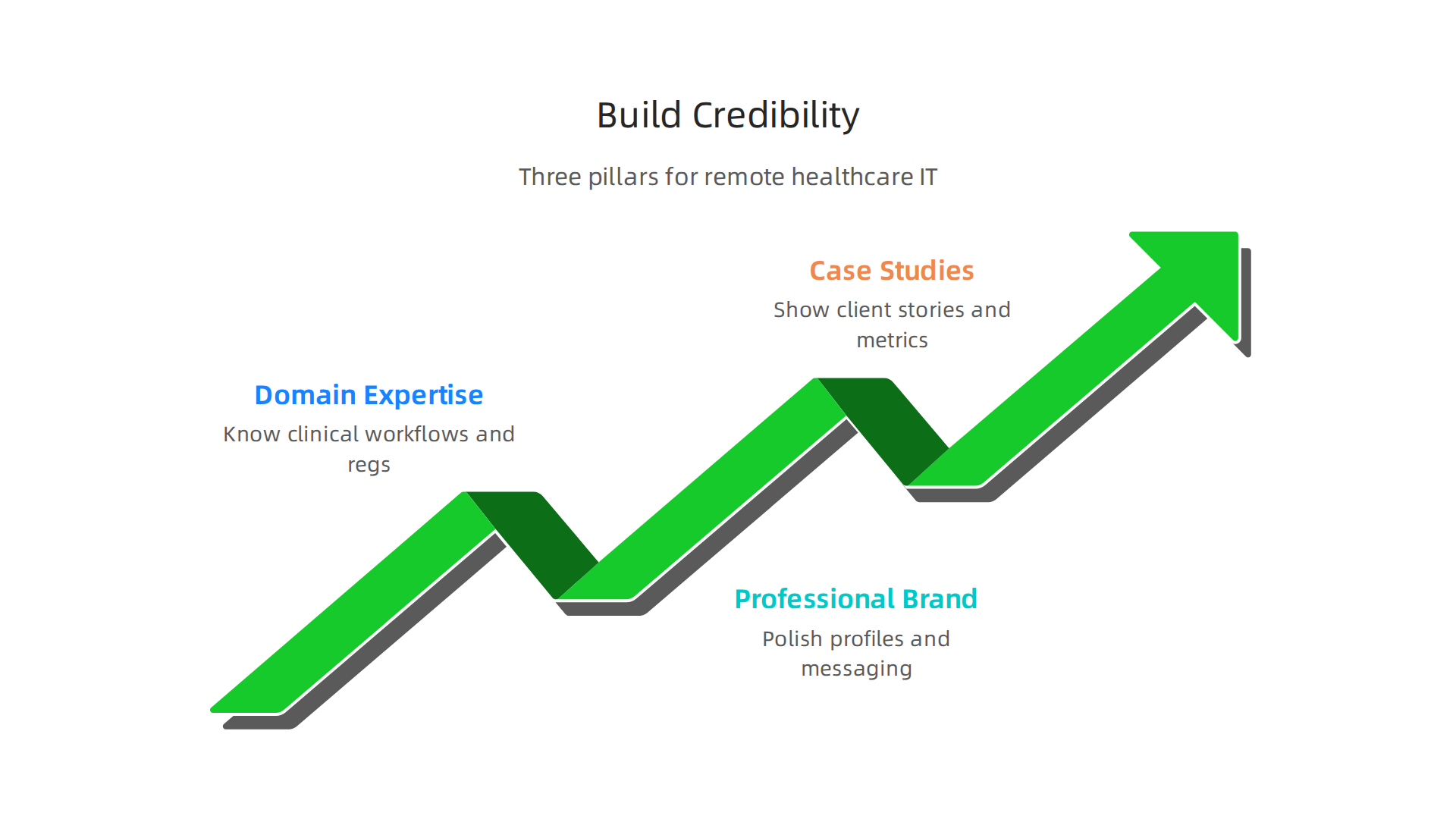
1. Develop Domain Expertise Strategically
You don’t need to be a doctor, but you must speak the language. Building foundational knowledge shows employers you’re a serious investment, not just a salesperson.
- Start with Foundational Courses: Platforms like Coursera offer excellent introductory Healthcare IT courses on electronic health records, data analytics, and cybersecurity. These provide a structured, credible way to learn the basics.
- Pursue Recognized Certifications: Earning a certification is a powerful signal. Focus on ones relevant to the sales and solutions side. For example, the HealthCare Information Security and Privacy Practitioner (HCISPP) credential is highly respected for roles involving IT security jobs remote in healthcare. Resources like Indeed provide a helpful overview of key healthcare IT certifications to consider.
- Build Knowledge Habits: Subscribe to industry newsletters from HIMSS or Healthcare IT News. Listen to podcasts featuring hospital CIOs. This daily immersion helps you understand current challenges, like interoperability or ransomware threats, making your conversations instantly more relevant.
2. Craft a Professional Brand That Speaks to Decision-Makers
Your online presence is your digital handshake. Make it count.
- Optimize Your LinkedIn Profile: Transform your headline from "Sales Closer" to "B2B Solutions Specialist | Connecting Health Systems with Secure, Compliant IT Infrastructure." Use your summary to articulate your understanding of healthcare’s unique pressures, like budget constraints and patient safety.
- Share Informed Content: You don’t have to be the expert who writes the white paper. You can be the curator who shares it. Comment intelligently on articles about new HIPAA guidelines or the adoption of AI in diagnostics. This positions you as an informed industry participant.
- Network with Intent: Connect with health IT project managers, clinical informaticists, and compliance officers. Engage with their content thoughtfully. Your goal isn’t to sell to them, but to learn the nuances of their jobs. This insight is pure gold when you’re later explaining a product’s value to a similar buyer.
3. Leverage Case Studies and Social Proof from Day One
You may not have healthcare case studies yet, but you have transferable proof of your ability to handle complex sales.
- Adapt Past Success Stories: Did you previously sell complex SaaS solutions? Frame that case study around solving a intricate business problem, navigating multi-stakeholder buy-in, and ensuring long-term client success. The core skill of managing a complex sales cycle is what healthcare employers need.
- Create a "Proof of Concept" Project: If you’re new to sales entirely, create a sample analysis. Pick a public healthcare tech company, research a product, and outline a hypothetical sales strategy for it. This demonstrates initiative and applied learning far better than a generic resume.
- Get Certified in Sales Methodology: While building healthcare knowledge, also validate your core sales skill. Pursuing a general sales certification shows you take the craft seriously. This foundational sales expertise, combined with your new healthcare knowledge, makes you a unique and compelling candidate.
Building credibility is a proactive project. It tells a hiring manager, "I am investing in understanding your world so I can be a valuable partner from day one." This approach transforms you from an unknown risk into a calculated, high-potential asset. For more on developing the strategic mindset needed for complex sales, explore our guide on the secret to finding high-ticket closing jobs.
The Future Outlook: Trends Shaping Remote Healthcare IT Careers
You’ve built credibility. You speak the language. Now, what’s next? Staying ahead in healthcare IT remote jobs means looking forward. The landscape isn’t static. In 2026, powerful trends are reshaping what solutions are needed and how you will sell them. Understanding these shifts isn’t just interesting. It’s a career advantage. Here’s what’s on the horizon for remote healthcare IT jobs.
1. The Rise of AI and Automation: From Hype to Everyday Tool
Artificial intelligence is no longer a futuristic concept in healthcare. It’s a practical tool creating real value. For closers, this changes everything.
- Your New Sales Pitch: AI is moving from hype to delivering hard, measurable returns on investment. Your conversations will shift from "what AI can do" to "how this specific AI tool reduces administrative burden, predicts patient risk, or cuts costs." Success depends on understanding specific use cases, like how AI is transforming care delivery by moving into clinical and operational workflows.
- Automation Creates New Problems (and Solutions): As routine tasks are automated, healthcare staff face new challenges. They need tools to manage these advanced systems, ensure data quality, and interpret AI-driven insights. Your role becomes selling the solution to the problems that automation itself creates.
- Required Skill Shift: You’ll need to grasp data fundamentals. You don’t have to be a data scientist, but understanding data interoperability, predictive analytics, and how machine learning models are trained will be crucial. This knowledge lets you confidently sell the complex IT security jobs remote teams rely on to protect this sensitive AI-driven data.
2. The Evolving Regulatory Landscape: Your Gateway to Opportunity
Regulation drives demand in healthcare. As rules change, new markets open up.
- Data Privacy Gets More Complex: Laws around patient data are constantly tightening. Every new regulation creates a need for compliant software and security infrastructure. Closers who can articulate how a product meets specific standards like HIPAA or newer state laws have a major edge. This expertise is critical for selling remote IT security jobs solutions.
- Telehealth Laws Mature: The rules governing virtual care are solidifying. This creates stability and growth for platforms that specialize in telehealth, remote patient monitoring, and digital therapeutics. Understanding the legal boundaries of where and how care can be delivered remotely allows you to target your sales pitches with precision.
- Opportunity Knocks: Each regulatory update is a sales opportunity. It signals a hospital or clinic may need to invest in new technology to stay compliant. Position yourself as the closer who understands not just the product, but the regulatory pressure behind the purchase.
3. The Next Phase of Remote Work: Hybrid and Distributed Mastery
Remote jobs in healthcare IT are here to stay, but the model is evolving.
- Hybrid Client Engagement: You may be remote, but your clients operate in a hybrid world. Mastering a mix of communication tools is key. This means flawless virtual demos, effective asynchronous communication via email or project boards, and the strategic use of occasional in-person meetings when it truly matters.
- Selling to Distributed Teams: The buying committee itself is often distributed. You might engage a CFO at headquarters, a clinical lead at a rural clinic, and an IT director working from home. Navigating this dynamic requires exceptional coordination and the ability to build consensus across a virtual table.
- The Distributed Closing Team: You’ll likely be part of a sales team that is also fully remote. This demands superior self-discipline, clear internal communication, and the use of collaborative CRM tools to manage long, complex sales cycles effectively.
The future of remote healthcare IT jobs is bright, but it belongs to the adaptable. It’s for the closers who see AI as a tool to explain, regulations as a map to opportunity, and remote work as a skill to master. By aligning your skills with these 2026 trends, you future-proof your career. To start positioning yourself for these high-value opportunities, learn more about the secret to finding high-ticket closing jobs in evolving fields like healthcare IT.
Actionable Next Steps: Your 90-Day Plan to Break Into Healthcare IT Remote Sales
Knowing the trends is one thing. Taking action is what gets you the job. To break into healthcare IT remote jobs, you need a clear, strategic plan. A structured 90-day approach prevents overwhelm and turns a big goal into manageable steps. Think of it like a 30-60-90 day sales plan for your own career launch. Here is your phased checklist.
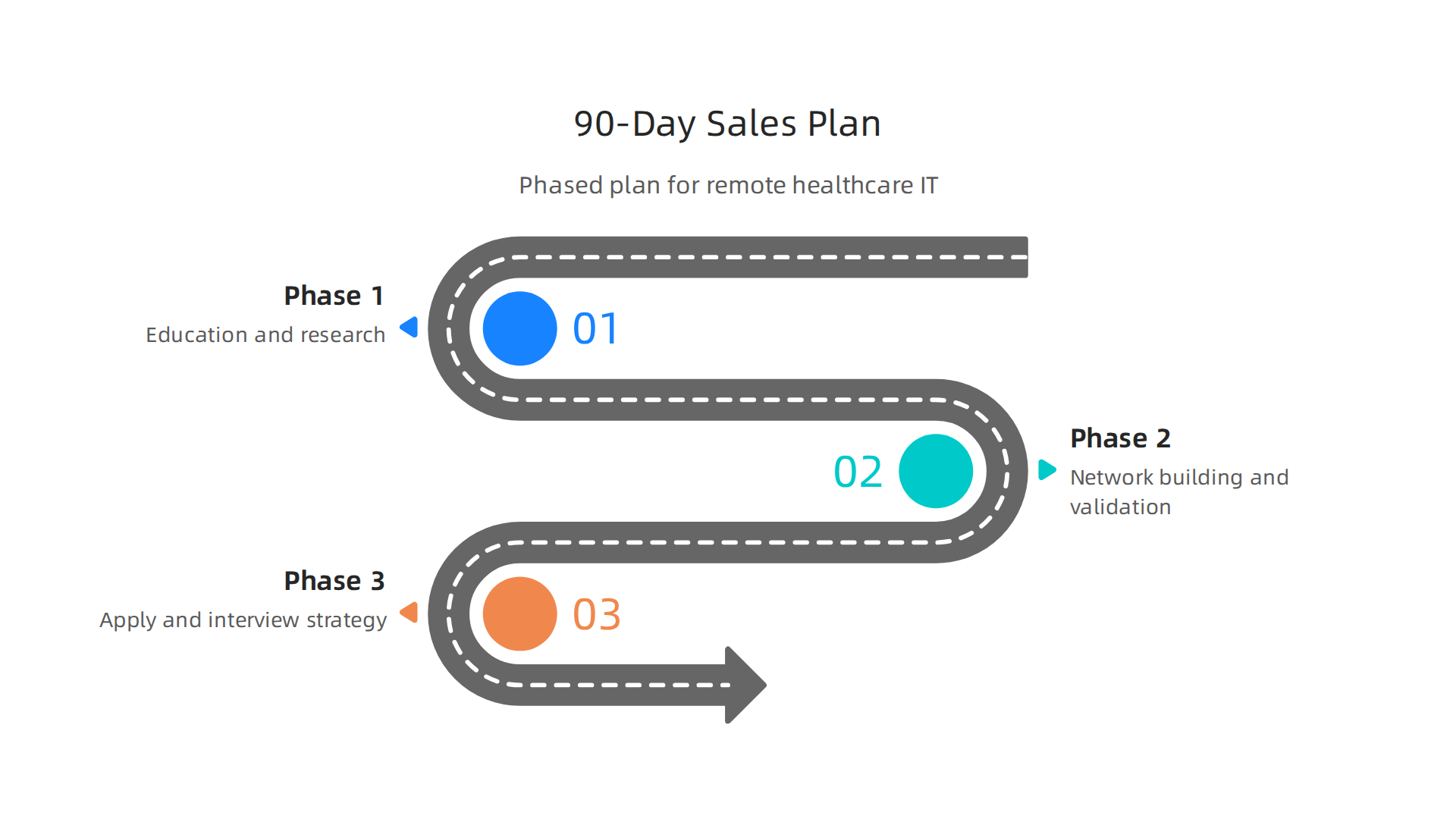
Phase 1: Days 1–30 | Education & Research Foundation
Your first month is for learning, not applying. Build your knowledge base so you speak the language of the industry.
- Complete a Foundational Certification: Start with a free or low-cost course on healthcare IT fundamentals, HIPAA basics, or healthcare sales. This proves initiative and gives you essential vocabulary.
- Deep Dive into the Market: Research 10-15 companies that sell remote healthcare IT jobs solutions. Understand their products, their competitors, and their target clients (hospitals, clinics, etc.).
- Listen and Learn: Attend one major virtual event, like a HIMSS conference session. Follow key industry voices on LinkedIn. Your goal is to absorb the current conversations about AI, security, and regulations.
Phase 2: Days 31–60 | Network Building & Skill Validation
Now, shift from learning to connecting. Your goal is to build relationships and test your new knowledge.
- Strategic Networking: Use LinkedIn to connect with 5-10 people in roles you want. Don’t ask for a job. Ask for a 15-minute “informational interview” to learn about their path and the skills they value most.
- Validate Your Skills: Create a simple “cheat sheet” that explains a common healthcare IT problem (like data interoperability) and how a specific type of software solves it. This exercise cements your understanding and becomes a talking point.
- Target Your Search: Refine your target company list based on your research. Identify which ones have remote IT security jobs or sales roles that align with your growing expertise.
Phase 3: Days 61–90 | Application & Interview Strategy
With a foundation and connections, you can now apply with confidence.
- Tailor Every Application: Never send a generic resume. For each healthcare IT remote jobs application, tweak your resume to highlight the relevant knowledge and skills you’ve built over the past 60 days.
- Prepare Your Story: Be ready to answer, “Why healthcare IT sales?” Your answer should weave together your research, your networking insights, and your genuine interest in the sector’s challenges.
- Ask Insightful Questions: In interviews, move beyond basic questions. Ask about how the company is adapting to new telehealth laws or how their product leverages AI. This shows deep engagement.
This measured, research-driven approach helps you avoid costly missteps with generic training. You become a knowledgeable candidate, not just another applicant. For a deeper guide on targeting these high-value roles, explore our resource on the secret to finding high-ticket closing jobs. Start your first 30 days today. Your future in remote healthcare IT jobs is built one smart step at a time.
Summary
This guide explains the landscape of remote healthcare IT jobs in 2026 and shows how sales professionals and career switchers can land high-value, remote roles. It defines common positions—like EHR sales, telehealth specialists, solutions consultants, and cybersecurity analysts—then outlines the specific technical, regulatory (HIPAA, HL7, FHIR), and soft skills employers expect. You’ll learn where to search for legitimate openings, how to vet postings and recruiters, and concrete ways to build credibility even without a clinical background. The article also covers market trends such as AI adoption, evolving regulations, and hybrid client engagement, and finishes with a focused 90-day plan to research, network, and apply effectively. Read this to understand earning potential, avoid scams, and take practical steps to become a trusted remote closer in health tech.



Get in Touch


